
Madison County Parole Versus Probation
Georgia divides parole decisions from field supervision. The State Board of Pardons and Paroles decides parole and maintains parole tools. The Georgia Department of Community Supervision, or DCS, supervises parolees and felony probationers in the community. A Madison County case may involve one agency, both agencies, or neither.
Probation is a court sentence served under set terms in the community. It may follow jail time, begin after prison, or replace part of confinement. Parole is conditional release from a state-prison sentence before that sentence expires. Leaving Madison County Jail after bond, time served, dismissal, or a local court order is not parole by itself.
| Point | Parole | Probation |
|---|---|---|
| Who orders it | State Parole Board | Sentencing court |
| What comes first | State prison | A court sentence |
| Public proof | Parolee search and Board record | Court disposition and DCS confirmation |
| Field supervision | DCS | DCS for felony probation |
- Parole
- Conditional community release from prison.
- Probation
- Court-ordered supervision in the community.
- Discharge
- The formal end of supervision.
- Absconder
- A supervised person reported as no longer complying with required contact or location rules.
Verify Madison County Release Supervision
Start with the custody path. A person released from Madison County Jail is not automatically under supervision. If the person served a Georgia prison term, check the Board and GDC record. If a Madison County judge imposed felony probation, read the court disposition and contact DCS. Compare identifiers because a shared name can lead to the wrong record.
- Search the Board’s parolee database by name. Compare the offense, county, office number, and all other identifiers shown.
- For someone still in prison, use the TPM lookup. A Tentative Parole Month is a review month, not proof of release.
- Read the Madison County sentencing record when probation may apply. The judgment states the term and whether probation follows custody.
- Contact DCS when the public result is unclear. Ask whether Elberton is the assigned field office.
- Use the jail release record only to confirm local custody. The full path for Madison County released inmates separates jail, prison, and supervision records.
GDC status and a parolee result cover different points in time. GDC tracks the prison record. The parolee search verifies released parolees. A court file remains the sound source for probation ordered in a Madison County case.
Madison County Supervision Office
Madison County does not use a DCS field office in Danielsville. The DCS Elberton field office serves Madison, Elbert, Franklin, Hart, and Oglethorpe counties and the Northern Judicial Circuit. That regional assignment is easy to miss when the jail release and court case occurred in Danielsville.
233 N Oliver Street
Elberton, GA 30635
Monday-Friday, 8:00 a.m.-4:30 p.m.
DCS main phone: 678-783-4337
The office can route questions about reporting and case assignment. It does not replace the Board’s parole decision or the court’s probation order. Have the full name and case or GDC number ready if known. A Madison County address does not mean the reporting office will be in Danielsville, so confirm the assigned location from the supervision paperwork before appearing in person.
This Elberton assignment is the local detail that connects a Madison County release to field supervision. DCS serves five counties and the Northern Judicial Circuit from this office. The regional structure also explains why a jail record, a Madison County court order, and a DCS office record may show different agency names while describing the same person's path. Use the court for the sentence, the Board for the parole decision, and DCS for field supervision.
The image below comes from the official DCS Elberton field-office page and documents the office serving Madison County.
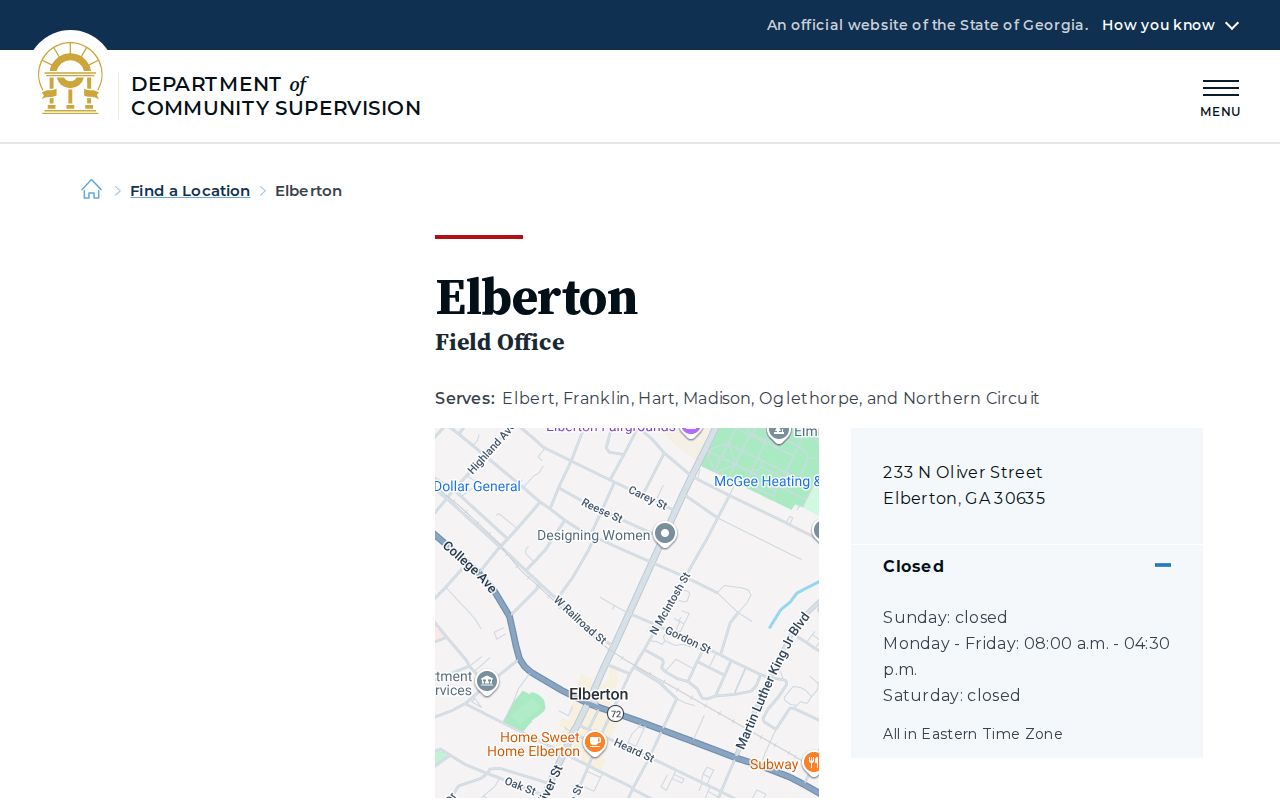
Its regional service area is why Madison County parole and felony-probation questions may be routed outside the county.
Madison County Supervision Violations
Conditions are rules attached to parole or probation. They may address reporting, residence, treatment, payment, travel, and lawful conduct, but the actual order controls. DCS supervises compliance. A court decides probation consequences, while the Board decides parole consequences.
No Madison County-specific public absconder list was found. An old booking does not prove a live warrant. A parolee arrested on a Board warrant for an alleged violation receives a preliminary hearing near the alleged violation so a hearing officer can decide whether probable cause exists and whether custody should continue while revocation is considered.
Georgia VINE can send custody-change notices from participating agencies, but it is not a supervision record. A VINE release alert does not prove that parole or probation ended. Check county warrants through the Sheriff’s Office or court and supervision through the Board or DCS.
Madison County Parole Decisions
Georgia’s public Board meetings are not individual inmate parole hearings. The Board posts monthly notices and agendas on its press-release page, though dates can change and meetings can be canceled. Those sessions concern public agency business. In Georgia, parole consideration rests on the case file, investigation, guidelines, prison conduct, and other material. The incarcerated person does not appear before the Board for a courtroom-style hearing.
For a non-life parole-eligible sentence, the Board may set a future TPM or deny parole. At final review, it can set a release date, postpone the month, cancel it due to misconduct or unmet terms, or withdraw a grant before it takes effect. Life cases use grant-or-deny decisions instead of the usual TPM path.
Most parole-eligible inmates become eligible after serving one-third of the sentence, but serious violent felonies, some recidivist cases, and life without parole are key exceptions. O.C.G.A. 17-10-6.1 adds special limits. O.C.G.A. 42-9-40 supports guidelines that weigh offense severity, conduct, and social factors. Eligibility never guarantees release.
Note: Check the Board’s current notice page because a posted monthly meeting may be rescheduled or canceled.
Madison County Supervision Discharge
Supervision ends through an official act, not because a name vanishes from a public search. Probation generally ends under the sentence and court record, subject to later court action. Parole ends when Board and DCS records show discharge or sentence completion. Release from prison may instead mark the start of a court-ordered probation term.
Keep the final notice or order. For parole, compare the Board result with GDC and DCS confirmation. For probation, obtain the sentencing disposition and any order that changes or ends the term. A stale portal entry should be checked with the agency that made it.
Madison Supervision Notification Limits
Georgia has notification tools, but they answer a different question from supervision verification. Georgia VINE can report custody changes from participating agencies and supports notification registration. The State Board's Victim Information Program has a separate process for registered victims or family members. Board materials describe release-notification calls and a four-digit PIN used to acknowledge them.
A notification that someone left confinement does not show every supervision condition. The Board says its program may notify when an inmate completes confinement, begins a court-ordered probation period after confinement, or receives parole release. Those are three different legal paths. Read the court order, parole record, and DCS assignment before deciding which applies.
The same limit applies to the Madison County jail roster. Disappearance from Current Inmates can reflect release or transfer, but it does not establish parole, felony probation, discharge, or an active violation. The agency that ordered or supervises the status remains the best source.
Madison Supervision Record Trail
A complete Madison County supervision check may require three records. The court judgment establishes probation and the sentence terms. GDC records establish the state-prison custody and release history. The Board record establishes parole consideration, a TPM, a grant or denial, and parole status. DCS then handles field supervision for parolees and felony probationers. No single portal replaces the others.
Use dates to reconcile them. A prison release date may also be the first day of parole or the start of a court-ordered probation period. A jail release after bond may have no post-release supervision at all. If the person moved from Madison County Jail to GDC, the local release date records a transfer, while the later GDC record controls the prison release. These distinctions prevent the same word, “release,” from collapsing separate events.
For probation, request the sentencing disposition and any later modification or discharge order from the court handling the case. For parole, compare the parolee search with the GDC status and contact DCS when office assignment or current reporting status remains unclear. Public records can lag an agency action, so note when each source was checked and ask the issuing office to resolve conflicting dates.
Registry status is also separate. Georgia's sex-offender registry covers people who meet statutory registration rules, including some people on probation, parole, or supervised release. An entry proves registry reporting, not the full terms of parole or probation. Verify each status through its own agency.