
Madison Projected Versus Actual Release
A projected date is an estimate or calculated endpoint based on the sentence and information available at that time. An actual date records when custody ended. Georgia also uses “Tentative Parole Month,” or TPM, for a possible future parole review point. A TPM is not a release date. The State Board of Pardons and Paroles says it is the month for final review when the Board may, if appropriate, set a parole release date.
For Madison County Jail, the distinction starts even earlier. A pretrial detainee has not received a final sentence, so there may be no term from which to compute a date. Release may follow bond, first appearance, dismissal, a court order, or transfer. A county-sentenced person's timing can depend on the judgment, sentence credit, holds, and jail processing. The public Madison County roster does not publish a local good-time formula or weekend adjustment.
Find Madison County Release Dates
Start with custody type, not with a single statewide search. Madison County Jail records cover local detention. GDC covers state prisoners and people with Georgia corrections records. The parole Board controls parole timing. Mixing those systems can turn a booking date, sentence end, or TPM into the wrong answer.
- Confirm whether the person is at Madison County Jail, in GDC custody, or already released.
- For local custody, obtain the sentencing order or bond record and ask the jail for the projected or scheduled release information it can confirm.
- For state custody, open the GDC Find an Offender tool and search by name, GDC ID, case number, or available descriptive fields.
- Compare birth date, physical details, offense, county, sentence, and facility before relying on a match.
- Review status, release date, maximum release date, and parole or discharge details that appear, then check the Board's TPM source when parole timing is relevant.
GDC advises users to verify public information through written correspondence with Inmate Records and Information at P.O. Box 1529, Forsyth, GA 31029. That warning matters when a date affects travel, pickup, court planning, or contact with the released person. The broader Madison County released inmate guide maps records after custody ends.
Madison GDC Release-Date Fields
The GDC tool is appropriate after a Madison County case results in state-prison custody or when the person has another GDC record. GDC's public instructions say users may search with name, ID, case number, and descriptive details. Its family guidance points to Find an Offender for charges, facility location, and release date. A local jail-only booking may never produce the same set of fields.
| Field or status | How to read it |
|---|---|
| Current status | Shows whether GDC reports custody, release, discharge, or another state status. |
| Facility | Identifies the state institution or former placement tied to the record. |
| Release date | May be future or completed depending on current status and record context. |
| Maximum release date | Represents a sentence endpoint, subject to the official record and applicable law. |
| Sentence and offense | Helps confirm identity and explains which restrictions may govern timing. |
| Parole or discharge detail | Separates conditional release from completion of the custodial or supervisory term. |
The official GDC search source is shown below.
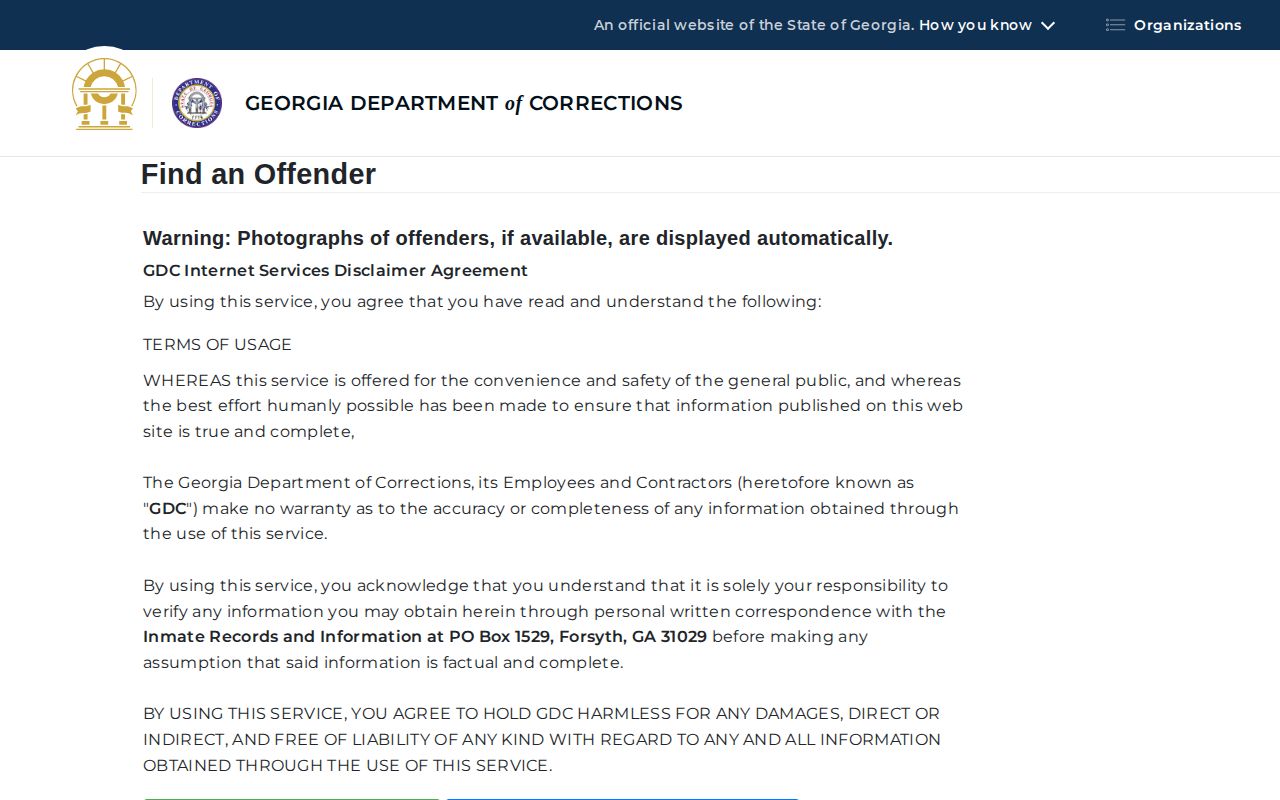
Its statewide fields should be used for GDC records, not as proof of a Madison County jail-only release.
Madison Tentative Parole Month
Georgia splits corrections custody from parole decision timing. GDC maintains the prison record, while the State Board publishes the Inmate TPM Lookup. The Board may set a future TPM for a non-life parole-eligible inmate or deny parole. At final review, it decides whether to establish a parole release date. The Board can change a prior decision any time before release.
A TPM may depend on good conduct, completion of treatment or other programs, residence-plan review, and the absence of unresolved detainers. Misconduct reports commonly cause postponement or cancellation. Life-sentenced cases use a grant-or-deny process rather than the ordinary TPM path. For that reason, copying the TPM month into a calendar as a guaranteed exit date is not supported.
The Board says most parole-eligible inmates become statutorily eligible after one-third of the prison sentence, but exceptions include serious violent felony cases, certain recidivists, and life without parole. Eligibility only opens consideration. It does not promise a TPM, a grant, or release on the first eligible date.
Georgia PIC Changes Madison Timing
Performance Incentive Credit, called PIC, is Georgia's program-based way to advance an eligible inmate's TPM. The Board describes satisfactory education, treatment, work, and conduct as relevant. When parole is tentatively scheduled, the Board sets both a TPM and a PIC date. The space between them is the greatest amount the TPM can move forward for good performance.
This is not a flat reduction for every state prisoner. Research identifies exclusions that include life sentences, a TPM set at one-third of the sentence, work release, boot camp, sentences of two years or less, and cases with no TPM. The Board also says poor performance has no matching fixed cap on how much time may be added. Misconduct can delay or cancel the tentative timeline.
That asymmetry is Madison County's key release-date computation angle. Eligible progress may advance a TPM by a limited few months, while poor conduct can push it back without the same maximum. The sentence, Board decision, and current GDC record must be read together. A county jail calculation should not borrow the PIC framework because PIC concerns eligible state-prison parole timing.
Madison Serious-Felony Release Limits
O.C.G.A. 17-10-6.1 creates special rules for listed serious violent felonies. The statute includes murder and felony murder, armed robbery, kidnapping, rape, aggravated child molestation, aggravated sodomy, and aggravated sexual battery. For covered non-life sentences, mandatory minimum portions cannot be suspended, stayed, probated, deferred, or withheld. These restrictions can make a general parole estimate misleading.
For a first-conviction serious violent felony carrying life imprisonment, the statute bars parole or early release administered by the Board until at least 30 years have been served. That minimum is not reduced by earned time, early release, work release, leave, or similar measures. Certain serious-violent-felony terms are served in full as imposed, with specified final-year transitional-center or work-release provisions.
Georgia should not be reduced to a generic “serve 85 percent” statement. The supported approach is offense-specific and sentence-specific. Read the judgment, identify the statute and crime date, then use the current GDC and Board records. A court or corrections records office can resolve terms that the public portal abbreviates.
Why Madison Release Dates Change
Several independent events can move or replace a projected date. Some arise from the sentence. Others arise from conduct, parole review, a new court order, or another agency's claim to custody. The result may be a later release, an earlier tentative parole point, or a transfer that is not a community release.
| Factor | Possible effect |
|---|---|
| PIC-eligible progress | May advance an eligible TPM within the Board-set PIC range. |
| Misconduct or unmet program terms | May postpone or cancel the TPM or release plan. |
| Parole grant, denial, or withdrawal | Can establish, remove, or delay a parole release date. |
| Court order or sentence correction | May change the legal term, credit, bond status, or authority for release. |
| Detainer or hold | Can send the person to another agency instead of the community. |
| Residence-plan review | May delay parole release until an acceptable plan is approved. |
A detainer is another agency's request to hold or transfer a person. It explains why a Madison County or GDC record can show the end of one custody period while the person remains confined elsewhere. Confirm the receiving agency before describing the event as release to the community.
Madison Jail Release-Date Limits
Madison County Jail holds pretrial, county-sentenced, state-sentenced, and city inmates. Each group can follow a different timing path. Pretrial release may turn on bond or a court order. A county sentence may end through time served, sentence expiration, court action, or transfer. A state-sentenced person may leave the jail for GDC while remaining incarcerated.
The public Eagle Advantage search has Current Inmates, Bookings Over Last 24 Hours, and Inmates by Booking Date with an option to include previous inmates. It does not publish a local formula for good time, sentence credit, weekend release, or transportation. Do not calculate a Madison County release date from a charge label or bond amount. Obtain the sentencing or bond order and ask the jail records office to confirm the physical release or transfer.
Madison County Magistrate Court handles first appearances, bond, extradition, committal, warrants, and certain misdemeanors. The Superior Court record carries felony disposition and sentence information. These court sources explain the authority behind a local date, while the jail record shows when the custody event was processed.
Confirm Madison Projected Release
Use notification as a final alert layer, not as the date calculation. Georgia VINE can provide custody updates from participating agencies and supports phone, email, text, app, or TTY methods where available. A VINE alert can show that a reported change occurred, but it does not replace the court order, GDC record, Board decision, or jail release record.
For state parole notifications, the Board's Victim Information Program uses a separate registration process and four-digit PIN. Calls may report completion of confinement, release to begin court-ordered probation, or parole release. Those outcomes have different supervision effects. The Madison County VINELink inmate search explains person-specific alerts.
Before making plans, record the source, the date checked, and the exact label shown. Then confirm with Madison County Jail for local custody, GDC for state custody, or the Board for parole. A later official record controls over an earlier projection.
A same-name match should be checked against the birth date, GDC number, case number, offense, sentencing county, and facility. If the public date conflicts with a court order or recent agency notice, ask the office maintaining the record to explain the difference. Do not estimate a new date by adding or subtracting days from an old portal entry. Sentence credit, PIC, misconduct, detainers, and Board action are agency determinations.
Keep county and state events on separate lines in any timeline. Record the Madison County booking, local release or transfer, GDC admission, TPM decision, and final prison release as distinct events. That simple structure makes clear whether the date answers a jail question, a prison question, or a post-release supervision question.